
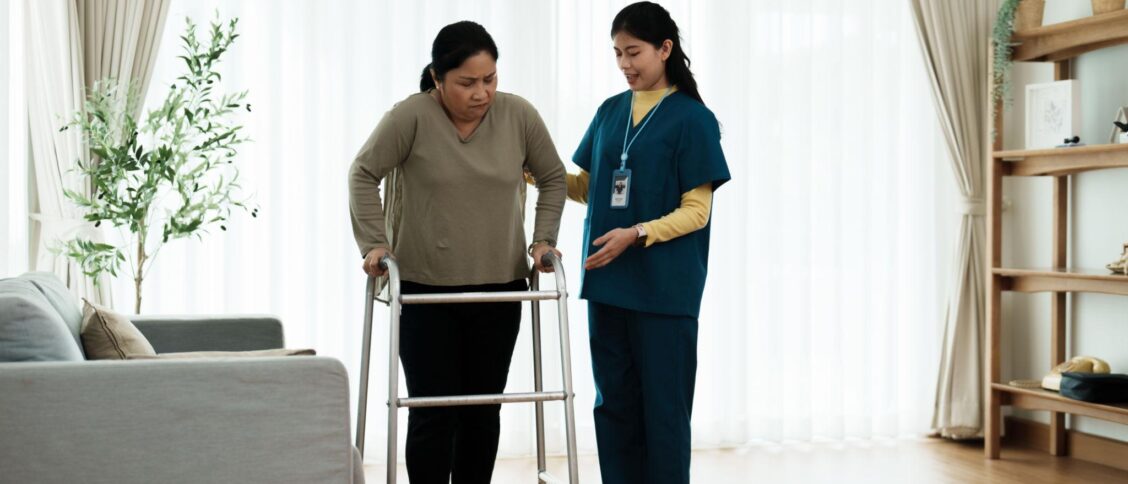

Physiotherapy and rehabilitation after surgery, stroke, fracture, or injury plays a decisive role in recovery outcomes. While clinic-based sessions with a DHA-registered physiotherapist are often the core of a rehabilitation programme, having the right equipment at home allows patients to continue their exercise programme between sessions, manage pain, and build independence progressively. This guide covers the key physiotherapy and rehabilitation products available at MedicalMart for home use in the UAE.
Why home physiotherapy equipment matters
Recovery from major orthopaedic surgery (hip or knee replacement), stroke rehabilitation, or injury management typically involves a structured programme of daily exercises, walking practice, and pain management. Outpatient physiotherapy sessions in Dubai are typically 2–3 times per week — meaning that 4–5 days of the week, progress depends on what the patient does at home.
The right equipment at home:
- Enables safe mobility during recovery phases where assistance is still needed
- Allows patients to complete prescribed exercise sets independently
- Manages pain effectively between physiotherapy sessions
- Reduces fall risk during early ambulation
Walking aids: finding the right support for the right stage
Walking aid selection should be guided by your physiotherapist based on the patient’s weight-bearing status and balance. Here is a practical overview:
Standard walking frames (Zimmer frames)
A four-point aluminium frame that provides maximum stability for patients with very low balance or initial weight-bearing after lower limb surgery. The patient lifts and moves the frame forward with each step. Standard frames are fixed-height — verify the patient’s elbow height before ordering.
Best for: immediate post-operative weight-bearing (partial weight-bearing to full weight-bearing transition); patients with severe balance impairment; early stroke rehabilitation.
Available at MedicalMart from approximately AED 120–250.
Wheeled walkers (rollators)
A four-wheeled walker with a seat and hand brakes. Unlike standard frames, rollators do not need to be lifted — the patient pushes forward continuously, which is safer for patients with limited upper limb strength. The built-in seat allows rest during longer walks — important for cardiac or respiratory patients who fatigue quickly.
Best for: patients who need support but can maintain a walking rhythm; older adults with generalised frailty; patients managing longer community distances.
Available at MedicalMart from approximately AED 350–700.
Forearm crutches (elbow crutches)
Crutches with a forearm cuff — the standard rehabilitation crutch for single-limb non-weight-bearing post fracture or surgery. More stable than axillary (underarm) crutches for most patients. Available in height-adjustable aluminium.
Best for: younger, stronger patients requiring non-weight-bearing or partial weight-bearing on one leg; long-term mobility aid for patients with neurological conditions.
Available at MedicalMart from approximately AED 80–200 per pair.
Walking sticks (canes)
Single or quad-base canes provide light stabilisation for patients in later stages of recovery with good balance but residual unsteadiness. A quad-base cane (four small feet rather than one point) provides more stability than a single-point stick.
Browse MedicalMart’s full walkers and walking sticks range for all available models and sizes.
TENS machines: managing pain at home
Transcutaneous Electrical Nerve Stimulation (TENS) is a non-pharmacological pain management technique that uses mild electrical impulses delivered through electrodes placed on the skin. It is widely used for:
- Musculoskeletal pain (back pain, joint pain, post-surgical pain)
- Arthritis management
- Nerve pain (sciatica, post-stroke neuropathic pain)
TENS does not treat the underlying condition — it provides pain relief that allows patients to complete rehabilitation exercises more comfortably and reduces reliance on pain medication.
How TENS works: The electrical impulses are thought to block pain signals travelling to the brain and stimulate the release of endorphins. The patient feels a tingling or buzzing sensation at the electrode sites, not discomfort.
Choosing a TENS unit:
- Look for units with adjustable intensity and frequency — different pain types respond to different settings
- Ensure the unit comes with self-adhesive electrode pads (typically 2 or 4 per session); pads are consumable and need regular replacement
- Portable, battery-operated units are most practical for home use
MedicalMart stocks TENS and physiotherapy electrotherapy equipment. Browse our physiotherapy equipment range.
Exercise and rehabilitation equipment
Resistance bands (therabands)
Colour-coded latex or non-latex resistance bands are one of the most versatile and cost-effective physiotherapy tools for home use. They are used for:
- Upper and lower limb strengthening
- Hip and shoulder rehabilitation exercises
- Balance and proprioception training
- Shoulder rotator cuff rehabilitation (very common need for Dubai’s active sports population)
Resistance levels correspond to colours — typically from lightest (yellow) through to heaviest (black). Your physiotherapist will specify which resistance levels to use for your programme.
Hand therapy equipment
For patients recovering from hand, wrist, or forearm injuries — or managing rheumatoid arthritis or post-stroke hand weakness:
- Therapy putty — colour-coded by resistance for grip and finger strength
- Hand grip exercisers — adjustable resistance for progressive strengthening
- Finger extension splints — for specific digit rehabilitation
Balance boards and wobble boards
Used in later-stage rehabilitation for ankle and knee injuries, wobble boards improve proprioception and balance control. Recommended for sports injury rehabilitation and fall prevention programmes in older adults.
Ankle weights
Ankle weight cuffs (typically 0.5 kg to 2 kg per cuff) are used to add progressive resistance to lower limb exercises prescribed by physiotherapists — particularly for hip and knee rehabilitation protocols.
Orthopedic supports and braces
Orthopedic supports play an important role in home recovery — providing joint stability during early rehabilitation and protecting healing structures during activity.
MedicalMart’s orthopedic supports range covers:
- Knee braces — from basic compression sleeves for mild support to hinged braces for ligament protection post-surgery
- Ankle supports — compression and semi-rigid options for sprain rehabilitation
- Wrist splints — for carpal tunnel, de Quervain’s syndrome, and wrist fracture recovery
- Lumbar supports — for back pain management and post-spinal surgery support
- Shoulder supports — for rotator cuff injuries and shoulder dislocation rehabilitation
- Cervical collars — soft and semi-rigid options for neck strain and post-cervical surgery recovery
Fit and sizing are critical for orthopedic supports — measure the relevant joint circumference and follow the brand’s sizing guide before ordering. MedicalMart’s team can advise on sizing for any product in this range.
Compression therapy
Compression stockings and garments are prescribed for:
- Deep vein thrombosis (DVT) prevention post-surgery (particularly after lower limb and orthopaedic procedures)
- Lymphoedema management
- Varicose vein management and leg oedema reduction
In the UAE, where long periods of sitting (due to the car-dependent lifestyle and sedentary office environments) increase DVT risk, compression stockings are frequently recommended post-flight and post-surgery.
Browse MedicalMart’s compression therapy range.
Compression stockings are classified by compression level in mmHg:
- Class 1 (15–21 mmHg): mild compression for travel and prevention
- Class 2 (23–32 mmHg): moderate compression for varicosities and mild lymphoedema
- Class 3 (34–46 mmHg): strong compression for severe lymphoedema and post-thrombotic syndrome (requires medical guidance)
Frequently asked questions
Do I need a physiotherapist’s prescription to buy a TENS machine in the UAE? TENS machines for home use are generally available without a prescription. However, they should not be used by patients with pacemakers, epilepsy, over the front of the neck, or during pregnancy without medical guidance. Always read the contraindications on the product label.
Can I use a rollator walker on carpet flooring in UAE apartments? Yes — rollators work on both hard floors and short-pile carpet. Deep-pile carpet can make rolling more effortful. If the patient’s home has significant carpeting, a standard frame (which is lifted, not rolled) may be more practical in those areas.
Does MedicalMart offer physiotherapy equipment for children? Some of the rehabilitation equipment on our platform is suitable for paediatric use (resistance bands, hand therapy tools). For specialised paediatric physiotherapy equipment, contact our team to discuss specific requirements.
How do I choose the right height for a walking frame or rollator? Stand upright with arms hanging naturally. The walking aid’s handles should reach the crease of the wrist. Most frames and rollators are height-adjustable. If you are ordering for a patient who cannot be measured directly, provide the patient’s height and our team can advise on the appropriate setting.
Can compression stockings be delivered the same day in Dubai? In-stock compression stockings are available for same-day or next-day delivery within Dubai. Specific compression classes and sizes are available — contact us to confirm before ordering.
Order physiotherapy and rehabilitation equipment with UAE-wide delivery
Browse MedicalMart’s physiotherapy equipment range, walking aids, orthopedic supports, and compression therapy — all priced in AED with fast delivery to Dubai, Abu Dhabi, Sharjah, and all UAE Emirates.
For guidance on which products suit your specific rehabilitation needs, contact: +971 55 360 3679 | pharmacy@medicalmart.ae
This article is for informational guidance. Home physiotherapy equipment should complement — not replace — a programme designed by a DHA-registered physiotherapist. Always follow your treating therapist’s exercise prescription.
