
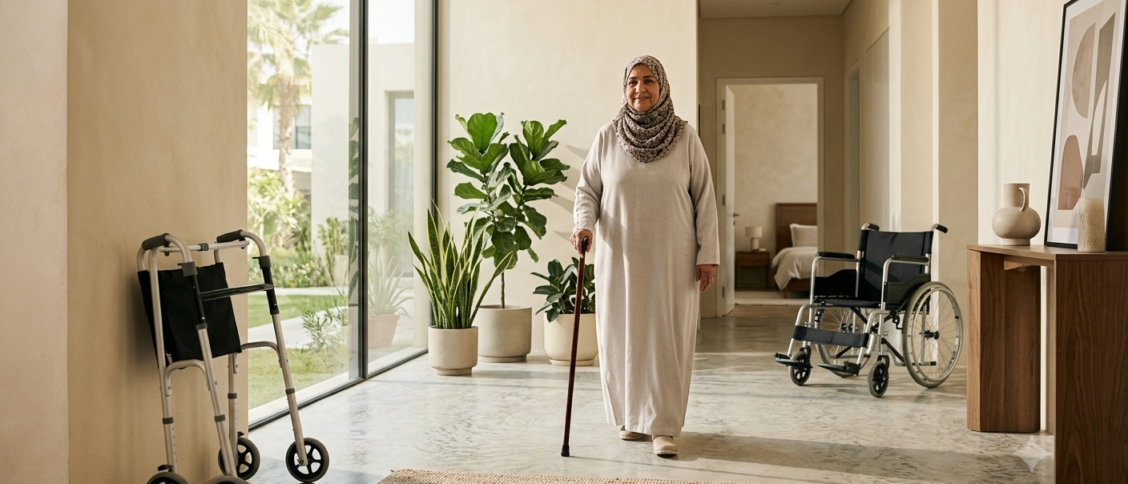

This guide compares the four most common mobility aids — canes, crutches, walkers, and wheelchairs — so you can understand which type generally suits which situation, along with key features to consider before buying. It is meant to support an informed purchase decision, not to replace an assessment by a doctor or physiotherapist.
This article is for general informational purposes only and does not replace professional medical advice. Consult a licensed healthcare provider for guidance specific to your condition.
Canes
Canes are generally suited to people who need mild extra balance or stability support but can still bear weight fairly normally on both legs. They come in several forms:
- Single-point canes are lightweight and simple, suited to minor balance support.
- Quad canes have a four-point base for extra stability, useful for users who need more support than a single-point cane offers but do not require a walker.
- Offset canes are shaped to better distribute weight through the handle, which some users find more comfortable for daily use.
When choosing a cane, correct height matters: the handle should generally sit at wrist height when the arm hangs naturally at the side, though a healthcare provider can confirm the right fit for a specific user.
Crutches
Crutches are typically used for short-to-medium-term recovery, such as after a leg or foot injury, when one side needs to bear little or no weight.
- Underarm (axillary) crutches are common for temporary injuries and offer strong support, though prolonged use can be tiring on the arms and underarms if not fitted or used correctly.
- Forearm (elbow) crutches distribute weight through the forearm rather than the underarm, and are often preferred for longer-term use since they can allow more natural arm movement.
Crutches usually require some instruction on correct technique — including how to navigate stairs safely — which a physiotherapist or doctor can provide.
Walkers
Walkers offer a wider, more stable base than a cane and are generally suited to users who need more substantial balance and weight-bearing support.
- Standard (pick-up) walkers are lifted and placed with each step, offering maximum stability but requiring more arm strength and a slower gait.
- Two-wheeled walkers allow the front to roll while the back legs stay planted, which can suit users who find lifting a standard walker difficult.
- Four-wheeled walkers (rollators) roll on all four wheels and often include a seat and brakes, suited to users who can walk with less support but benefit from being able to rest partway through longer distances.
Consider where the walker will be used most: a rollator with a seat can be helpful for trips to shopping centers or clinics, while a standard walker may suit primarily indoor use.
Wheelchairs
Wheelchairs are generally appropriate when walking is not possible or not advisable for an extended period, whether due to injury, surgery recovery, or a longer-term condition.
- Manual wheelchairs are self-propelled or pushed by a caregiver and are generally lighter and more affordable than powered options.
- Transport (companion) chairs are lighter-weight manual chairs designed to be pushed by a caregiver rather than self-propelled, useful for outings and appointments.
- Powered/electric wheelchairs allow independent mobility for users who cannot self-propel a manual chair, though they are heavier and need charging and more storage space.
Seat width, weight capacity, and whether the chair needs to fold for transport or storage are all practical factors to check before buying, alongside how it will be used day to day — for example, moving between home and vehicle, or navigating tiled versus carpeted floors.
Matching the Right Aid to the Situation
As a general guide: mild balance needs often point toward a cane, temporary single-limb injuries often point toward crutches, more substantial balance or endurance needs often point toward a walker or rollator, and an inability to walk safely or for extended periods often points toward a wheelchair. A doctor or physiotherapist can assess gait, strength, and recovery stage to confirm the right choice, since using the wrong aid — or one fitted incorrectly — can increase fall risk rather than reduce it.
Practical Considerations for UAE Homes
Tiled and marble flooring, common in UAE homes, can be more slippery than carpet, so rubber-tipped canes, crutches, and walker feet should be checked regularly for wear. If the home has stairs, ask a healthcare provider about safe techniques for the specific aid, and consider whether a folding option is needed for transport by car or use across different locations, such as a home and a majlis area.
You can browse Medicalmart Pharmacy’s full range of mobility equipment, including canes, crutches, walkers, and wheelchairs, at https://www.medicalmart.ae/category/mobility-equipment, with delivery available across all seven Emirates.
Frequently Asked Questions
What is the main difference between a walker and a rollator?
A standard walker has four legs and no wheels, so it is lifted and placed with each step, offering maximum stability. A rollator has wheels on all four legs, often with a seat and brakes, allowing a continuous rolling motion that suits users who need less support but want the option to rest.
Are forearm crutches better than underarm crutches?
Neither is universally better — underarm crutches are common for short-term injuries and offer strong support, while forearm crutches distribute weight differently and are often preferred for longer-term use since they allow more natural arm movement. The right choice depends on the individual’s condition and comfort.
How do I know if someone needs a cane or a walker?
As a general rule, a cane suits mild balance support needs where the person can bear weight fairly normally on both legs, while a walker suits more substantial balance or stability needs. A physiotherapist or doctor can assess this more precisely based on strength, gait, and recovery stage.
Can a manual wheelchair be used without a caregiver’s help?
Many manual wheelchairs are self-propelled and can be used independently by someone with sufficient upper body strength, while transport (companion) chairs are lighter and designed specifically to be pushed by a caregiver. The right type depends on the user’s strength and mobility needs.
Does Medicalmart Pharmacy deliver mobility aids to Sharjah, Ajman, Fujairah, Ras Al Khaimah, and Umm Al Quwain, not just Dubai and Abu Dhabi?
Yes. Medicalmart Pharmacy delivers across all seven Emirates using the same standard 7–10 day delivery window and flat AED 20 shipping fee, regardless of which Emirate you’re ordering to.
Is there a difference between ordering from the Dubai branch and the Abu Dhabi branch?
No — both the Al Hudaiba, Dubai branch and the Khalidiya, Abu Dhabi branch draw from the same catalog and pricing, so an order placed online is fulfilled the same way regardless of which branch is closer to you. In-person viewing is available at either location.
Which Emirate has the nearest physical branch to visit before buying?
Medicalmart Pharmacy has two physical branches — Al Hudaiba in Dubai and Khalidiya in Abu Dhabi. Customers in Sharjah, Ajman, Fujairah, Ras Al Khaimah, or Umm Al Quwain order online with delivery, since there is currently no physical branch in those Emirates.