
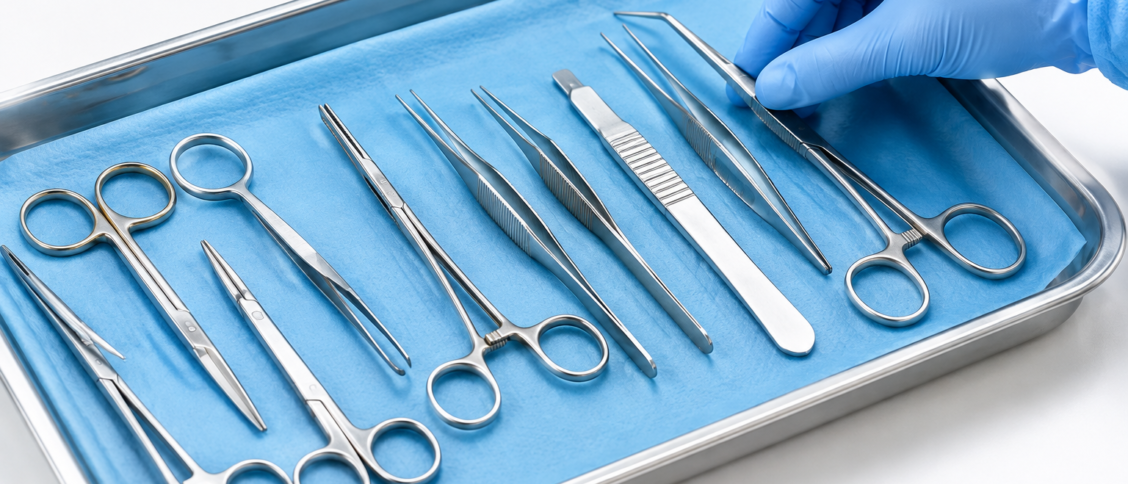

Surgical instruments range from basic scissors and forceps to specialized clamps and retractors, and choosing the right ones depends on the procedure and setting. This guide outlines common instrument categories, what to check before purchasing, and mistakes to avoid when stocking a clinic or home care kit. It is aimed at clinical buyers and caregivers sourcing supplies in the UAE.
This article is for general informational purposes only and does not replace professional medical advice. Consult a licensed healthcare provider for guidance specific to your condition.
Who needs this
Clinics, hospitals, and nursing homes across the UAE need a reliable stock of surgical instruments for routine and specialized procedures, while home caregivers may need select basic instruments — such as scissors or forceps — as part of wound care or dressing changes recommended by their treating clinician. Any instrument used for an invasive procedure should be selected and used according to guidance from a qualified healthcare professional; this article covers general product categories only.
Types available
Scissors come in several forms, including straight and curved surgical scissors, bandage scissors, and suture-cutting scissors, each shaped for a specific task such as cutting tissue, dressings, or sutures.
Forceps are used for grasping or holding tissue, dressings, or instruments, and range from fine-tipped dressing forceps to toothed tissue forceps, depending on the level of grip required.
Scalpels and blades are used for precise cutting in clinical settings, typically supplied as disposable blades fitted to reusable handles, or as fully disposable scalpel units.
Clamps and hemostats are used to control bleeding or hold tissue and instruments in place during a procedure, available in a range of jaw lengths and curvatures for different applications.
Retractors hold back tissue or organs to improve visibility during a procedure and range from simple handheld designs to self-retaining models used in more complex settings.
What to look for
Material quality matters: most reusable surgical instruments are made from surgical-grade stainless steel, which should be checked for smooth finishing, secure joints (for hinged instruments), and resistance to corrosion under repeated sterilization cycles. Clinics should confirm whether an instrument is designed for reuse (and compatible with their sterilization process) or intended as single-use/disposable, since using a disposable instrument beyond its intended single use is not appropriate. For institutional buyers, checking DHA-appropriate sourcing and requesting consistent, bulk-order availability helps avoid stock shortages for commonly used instruments.
Ergonomics and instrument size should match the user and the procedure — a mismatch between instrument size and the task can make a procedure more difficult and increase the risk of error, which is one reason instrument selection should involve the clinician performing the procedure.
Common mistakes to avoid
A common mistake is treating all “surgical scissors” or “forceps” as interchangeable without checking the specific design intended for the task, such as using tissue-cutting scissors for bandages, which can dull the blade and reduce cutting precision over time. Reusing single-use instruments to save cost is another risk, as it can compromise sterility. Clinics should also avoid letting instrument stock run low on frequently used items — building a reorder routine, supported by a supplier who can handle bulk orders, helps avoid last-minute shortages.
For home caregivers, using any instrument for a wound-care task beyond what a discharge nurse or doctor has specifically shown should be avoided; when in doubt, ask your care team before proceeding.
You can browse the full range in Medicalmart’s surgical instruments category at https://www.medicalmart.ae/category/surgical-instruments, which serves both individual buyers and institutions across the UAE.
Frequently Asked Questions
What is the difference between surgical scissors and bandage scissors?
Surgical scissors are generally designed for cutting tissue or sutures with precision, while bandage scissors have a blunted tip designed to safely cut dressings or bandages without risk to the skin underneath.
Are surgical instruments from Medicalmart reusable or disposable?
Medicalmart’s surgical instruments category includes both reusable, sterilizable instruments and single-use disposable options, so check each product listing for its intended use.
Can I buy surgical instruments for home wound care?
Basic instruments like scissors or forceps may be part of a home wound-care routine if recommended by your treating clinician, but any instrument used for a procedure should match what your care team has specifically advised.
Does Medicalmart support bulk orders for clinics and hospitals?
Yes, Medicalmart offers B2B and bulk ordering for hospitals, clinics, and nursing homes across all seven Emirates.
