
This article is for general informational purposes only and does not replace professional medical advice. Consult a licensed healthcare provider for guidance specific to your condition.
This guide walks through what a well-stocked first aid kit should contain, how home and office needs differ, and how to keep your kit organized and ready to use. By the end, you’ll have a practical checklist to build or upgrade your own kit.
Who Needs a First Aid Kit
Every household and workplace benefits from having a first aid kit within easy reach. Homes with children, elderly family members, or anyone managing minor daily risks (kitchen cuts, falls, sports scrapes) need a kit stocked for everyday incidents. Offices, retail spaces, and other workplaces across the UAE need kits that address minor injuries common to their environment, often as part of workplace safety practices. Caregivers looking after family members with specific health needs may also want a kit tailored to those requirements, ideally put together with input from a healthcare provider.
What to Include
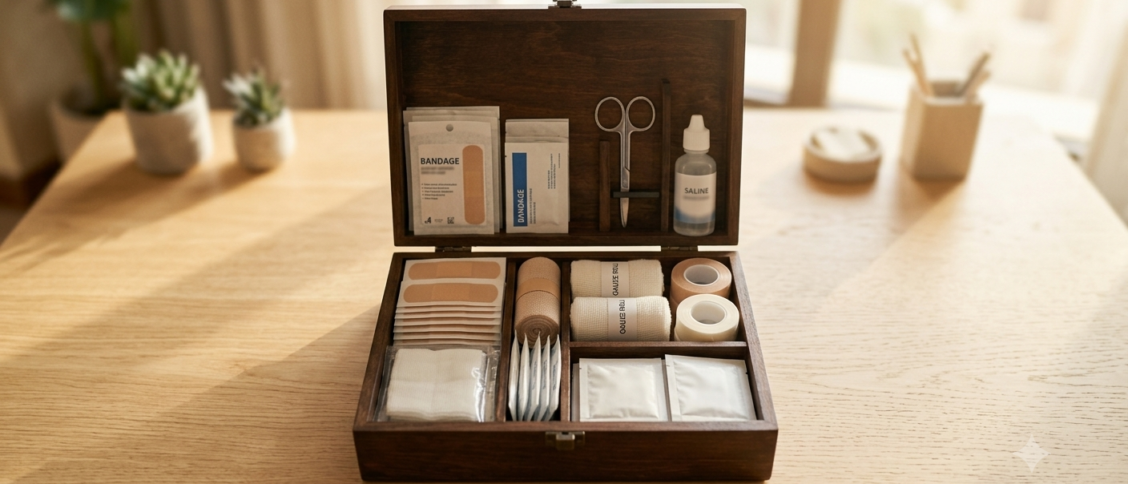
Wound care basics: adhesive bandages in various sizes, sterile gauze pads, adhesive tape, and antiseptic wipes or solution for cleaning minor cuts and scrapes.
Bandaging supplies: elastic (crepe) bandages for wrapping sprains, triangular bandages for slings, and non-stick dressing pads for larger wounds.
Tools: fine-point tweezers for splinters, blunt-tip scissors, disposable gloves (nitrile or another latex-free option), and a digital thermometer.
Skin and burn care: burn gel or dressings for minor burns, and a mild skin-irritation cream (check labeling and ask a pharmacist about appropriate use).
OTC medicine essentials: basic pain and fever relief, antihistamines for minor allergic reactions, oral rehydration salts (particularly useful in the UAE’s heat), and upset stomach remedies, chosen based on what your household or workplace typically needs.
Instant cold packs: useful for minor swelling or strains, especially relevant for active households or workplaces with physical tasks.
Documentation: a basic first aid reference card, and a list of emergency contact numbers, including your nearest clinic or hospital.
Home vs. Office Kits: Key Differences
A home kit should reflect the household’s makeup — more pediatric-sized bandages and child-safe items if there are young children, or specific supplies for family members with known conditions, ideally chosen in consultation with a healthcare provider. An office or workplace kit, by contrast, is typically built around the number of employees, the nature of the work, and any relevant UAE workplace safety guidance for the sector. Institutional buyers such as clinics, schools, and larger offices often need multiple kits distributed across different areas rather than a single central box, and may prefer bulk ordering for consistent stock across locations.
What to Look For When Buying
- Container quality: A sturdy, clearly labeled box or bag that’s easy to open quickly and keeps contents organized.
- DHA-approved sourcing: Buying medical supplies from a DHA-approved retailer helps ensure items meet recognized quality standards.
- Expiry dates: Check expiry dates on antiseptics, creams, and any OTC medicine included, and plan to review your kit periodically.
- Climate-appropriate storage: In the UAE’s heat, avoid storing kits in direct sun or hot vehicles for extended periods, as heat can affect certain contents; check product labeling for storage guidance.
- Completeness versus customization: Pre-assembled kits are a convenient starting point, but adding a few extra items suited to your household or workplace often makes the kit more useful.
Common Mistakes to Avoid
The most common mistake is buying a kit once and never checking it again — expired antiseptics, used-up bandages, or a missing thermometer battery can leave you unprepared when you actually need it. Storing the kit somewhere hard to reach in an emergency, such as a high shelf or a locked cabinet without quick access, defeats its purpose. Another common gap is failing to tailor the kit at all; a generic kit is a good base, but every home and workplace has slightly different needs. Ready to put together or refresh your kit? You can browse Medicalmart’s first aid category at https://www.medicalmart.ae/category/firstaid for supplies to build a kit suited to your home or office.
Frequently Asked Questions
How often should I check my first aid kit?
It’s good practice to review your kit every few months, checking expiry dates on antiseptics and medicines and restocking anything that’s been used.
What’s the difference between a home and office first aid kit?
A home kit is generally tailored to the household’s members, such as children or elderly family members, while an office kit is typically sized to the number of employees and the nature of the work performed.
Can I order first aid supplies in bulk for my business?
Yes, Medicalmart supports B2B and bulk ordering for institutions such as offices, schools, and clinics across the UAE; reach out via pharmacy@medicalmart.ae or +971 55 360 3679.
Does a first aid kit need prescription medicine?
No, a standard first aid kit typically contains OTC supplies, wound care materials, and basic equipment; Medicalmart does not dispense prescription medicines, so kits are built from OTC and equipment items.