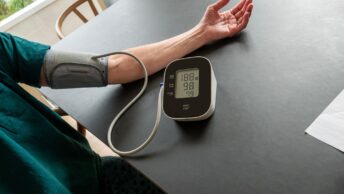


This guide covers the different types of home blood pressure monitors, the features that matter most when choosing one, and how to take an accurate reading at home. It is intended for individuals and caregivers who want to track blood pressure between doctor visits, not as a substitute for clinical diagnosis.
This article is for general informational purposes only and does not replace professional medical advice. Consult a licensed healthcare provider for guidance specific to your condition.
Types of Home Blood Pressure Monitors
Upper arm monitors. These are generally considered the standard choice for home use because the upper arm position is close to heart level, which tends to produce more consistent readings. Most are automatic, inflating and measuring with the press of a button.
Wrist monitors. Compact and convenient, wrist monitors can be a reasonable option for people who find an arm cuff uncomfortable or hard to fit, such as those with a larger arm circumference. However, they are more sensitive to hand and wrist position, so correct technique matters even more.
Manual (aneroid) monitors. These require a stethoscope and some training to use accurately, so they are more commonly used in clinical settings than at home, though some caregivers with medical training prefer them.
For most home users, an automatic upper arm monitor offers the best balance of ease of use and reliable positioning.
What to Look for When Choosing a Monitor
Cuff size. This is one of the most important factors for accuracy. A cuff that is too small or too large for the user’s arm can produce misleading readings. Check the manufacturer’s arm circumference range before buying, and look for monitors that include or offer a range of cuff sizes.
Validation. Look for monitors that have been clinically validated for accuracy, which is usually indicated on the packaging or manufacturer’s documentation.
Display and memory. A large, easy-to-read display is helpful, especially for elderly users. Memory storage for multiple readings — and ideally the ability to store readings for more than one user — is useful for tracking trends over time to share with a doctor.
Irregular heartbeat detection. Some monitors include a feature that flags possible irregular heartbeats during a reading. This is not a diagnostic tool, but it can be a helpful prompt to mention findings to your doctor.
Power source. Battery-only, mains-powered, or dual-power options are all available. If the monitor will be used daily, a mains-power option or rechargeable battery may be more practical than replacing batteries frequently.
How to Take an Accurate Reading
- Sit quietly for about five minutes before measuring, with your back supported and feet flat on the floor.
- Rest your arm on a table so the cuff is roughly at heart level.
- Avoid caffeine, exercise, and smoking for at least 30 minutes beforehand.
- Keep the cuff on bare skin rather than over clothing.
- Stay still and avoid talking during the measurement.
- Take two or three readings a minute or two apart and note the results, rather than relying on a single reading.
Measuring at the same time of day, such as morning and evening, can make it easier to spot patterns to discuss with your healthcare provider.
Caring for Your Monitor in the UAE Climate
Heat and humidity can affect electronic components and battery performance over time. Store the monitor and its cuff away from direct sunlight and excessive heat, such as inside a car left outside during summer. Periodically check the monitor’s accuracy against a clinical reading, such as one taken at a pharmacy or clinic visit, since home monitors can drift out of calibration over months of use.
Choosing the Right Monitor for Your Household
If several household members need to track their blood pressure, look for a monitor with multi-user memory and, if arm sizes vary significantly, confirm the cuff size range covers everyone who will use it. For caregivers monitoring an elderly relative, a monitor with a simple one-button operation and large display tends to reduce user error. You can browse the full range of blood pressure monitors and other diagnostic tools at Medicalmart Pharmacy at https://www.medicalmart.ae/category/diagnostic-tools-and-supplies, with delivery available across all seven Emirates.
Frequently Asked Questions
Are wrist blood pressure monitors as accurate as upper arm monitors?
Upper arm monitors are generally considered more reliable for most users because the arm position is closer to heart level and less sensitive to positioning errors. Wrist monitors can still be useful but require more careful attention to hand and wrist placement during measurement.
How do I know what cuff size I need?
Measure the circumference of your upper arm at the midpoint between your shoulder and elbow, then check this against the size range listed by the monitor manufacturer. Using an incorrectly sized cuff is one of the most common causes of inaccurate home readings.
Why do my readings vary between measurements taken minutes apart?
Some variation between consecutive readings is normal due to factors like movement, breathing, or brief anxiety. Taking two or three readings a minute or two apart and looking at the pattern, rather than a single number, gives a more reliable picture.
How often should I replace or recalibrate my home blood pressure monitor?
There is no fixed replacement schedule, but it is reasonable to check your monitor’s accuracy against a clinical reading periodically, such as during a pharmacy or doctor visit, especially after a year or more of regular use.
Does Medicalmart Pharmacy deliver a blood pressure monitor to Sharjah, Ajman, Fujairah, Ras Al Khaimah, and Umm Al Quwain, not just Dubai and Abu Dhabi?
Yes. Medicalmart Pharmacy delivers across all seven Emirates using the same standard 7–10 day delivery window and flat AED 20 shipping fee, regardless of which Emirate you’re ordering to.
Is there a difference between ordering from the Dubai branch and the Abu Dhabi branch?
No — both the Al Hudaiba, Dubai branch and the Khalidiya, Abu Dhabi branch draw from the same catalog and pricing, so an order placed online is fulfilled the same way regardless of which branch is closer to you. In-person viewing is available at either location.
Which Emirate has the nearest physical branch to visit before buying?
Medicalmart Pharmacy has two physical branches — Al Hudaiba in Dubai and Khalidiya in Abu Dhabi. Customers in Sharjah, Ajman, Fujairah, Ras Al Khaimah, or Umm Al Quwain order online with delivery, since there is currently no physical branch in those Emirates.