
Whether following a minor surgical procedure, managing a chronic wound related to diabetes, or caring for a family member after hospital discharge, wound care at home in the UAE requires the right supplies and the right technique. This guide walks through wound dressing types, sterile kits, and practical guidance for caregivers — including the signs that a wound needs professional assessment.
Understanding wound types before choosing a dressing
Not all wounds require the same approach. The right dressing depends on the wound type, depth, amount of exudate (fluid), and whether infection is present or at risk.
Acute wounds (surgical incisions, lacerations, minor burns, abrasions) generally heal predictably in days to weeks with appropriate first-line care.
Chronic wounds (diabetic foot ulcers, pressure ulcers, venous leg ulcers) require sustained wound management and often specialist oversight. In the UAE, where diabetes prevalence is among the highest in the world — affecting around 19% of UAE adults according to WHO data — diabetic foot ulcers are a particularly significant concern for home caregivers.
The most important wound care principle: moist wound healing
Research consistently shows that wounds heal faster and with less scarring in a moist environment. Traditional approaches (leaving wounds open to air or applying dry gauze that sticks to the wound bed) have largely been replaced by modern moist wound healing dressings. The role of a good dressing is to:
- Maintain appropriate moisture at the wound site
- Absorb excess exudate without letting the wound dry out
- Protect the wound from external contamination
- Allow oxygen exchange
- Minimise pain and disruption at dressing changes
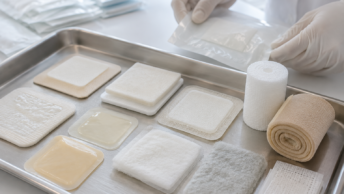
Wound dressing types and when to use them
Adhesive island dressings
A central absorbent pad surrounded by an adhesive border. The most common post-operative dressing for sutured or stapled surgical wounds. Easy to apply and remove, available in multiple sizes.
Best for: clean surgical wounds, minor lacerations post-closure, superficial abrasions.
Hydrocolloid dressings
A gel-forming dressing that creates and maintains a moist wound environment. As the wound produces exudate, the dressing forms a gel — the characteristic bubble appearance is normal and indicates the dressing is working. Can stay in place for 3–7 days.
Best for: superficial to partial-thickness wounds with low-to-moderate exudate; pressure injuries Grades 1–2; minor burns.
Transparent film dressings
A thin, transparent, semipermeable polyurethane film. Allows wound inspection without removal, waterproof (suitable for showering), but has minimal absorbency.
Best for: low-exudate wounds and superficial abrasions; IV cannula site protection; secondary dressing over foam or hydrogel.
Foam dressings
Soft, absorptive foam sheets that manage moderate to heavy wound exudate. Available bordered (self-adhesive) or non-bordered (requiring tape or a secondary dressing). Some foam dressings include silicone contact layers for gentle removal.
Best for: moderately to heavily exuding wounds; pressure ulcers Grades 2–3; post-operative wounds with higher drainage.
Alginate dressings
Derived from seaweed, alginate dressings are highly absorbent and form a gel on contact with wound exudate. Ideal for heavily exuding or bleeding wounds.
Best for: heavily exuding wounds; cavity wounds; post-operative donor sites.
Antimicrobial dressings (silver or iodine-based)
Dressings impregnated with silver or iodine for wounds that are critically colonised (high bacterial load) or infected. Reduces bacterial burden at the wound surface. Should be used when indicated — not as a routine first-line dressing.
Best for: infected or critically colonised wounds (indicated by increasing pain, warmth, purulent exudate, or odour); use under guidance of a nurse or physician.
Gauze
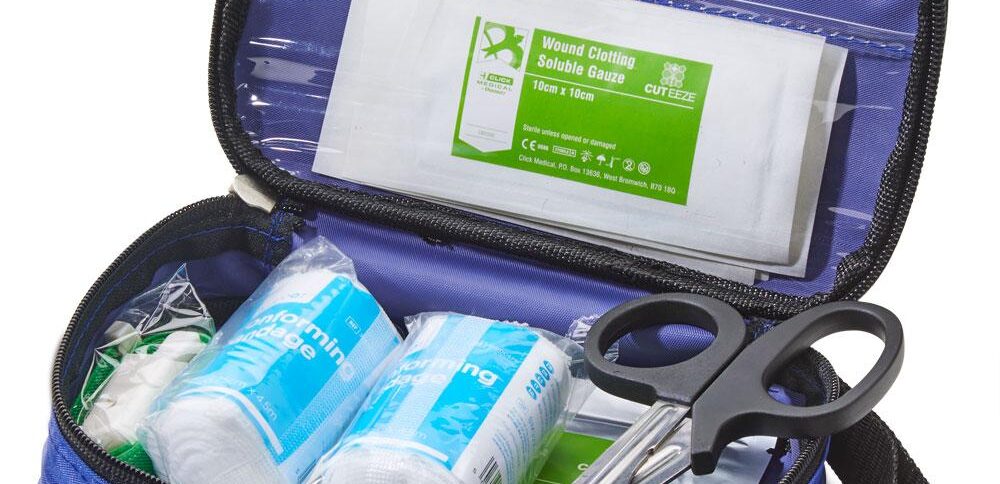
Traditional sterile gauze remains essential in every wound care kit — for wound cleaning, as a secondary absorbent layer, and for packing deep wounds under clinical supervision.
Browse MedicalMart’s wound care range and gauze products.
What should be in a home wound care kit?
MedicalMart’s dressing kits are pre-assembled for standard wound dressing procedures. A complete home wound care kit should include:
- Sterile gauze squares (5 × 5 cm and 10 × 10 cm)
- Adhesive island dressings (multiple sizes)
- Sterile saline sachets (10 ml) for wound irrigation — do not use tap water in the UAE on open wounds
- Sterile gloves (pairs)
- Sterile forceps (for handling dressings without touching the wound bed)
- Medical tape (hypoallergenic)
- Alcohol-free wound cleanser or antiseptic wipes for surrounding skin only (not wound bed)
- Waste bag for used dressings
Step-by-step home wound dressing technique
- Wash hands thoroughly for 20 seconds before beginning
- Prepare your surface — lay out all supplies on a clean, dry surface before starting
- Remove the old dressing — if it is stuck, soak it gently with sterile saline first; never pull a dry dressing from a healing wound
- Inspect the wound — note size, colour, exudate type, and surrounding skin; if you see increasing redness, warmth, swelling, or purulent (green/yellow) discharge, contact a healthcare professional before reapplying a dressing
- Clean the wound — gently irrigate with sterile saline using a syringe or saline sachet; clean from the wound outward using gauze
- Apply the dressing — place the appropriate dressing over the wound without touching the wound-contact surface; secure edges with medical tape if needed
- Record and monitor — note the date, dressing type used, and any changes to the wound’s appearance
When to call a nurse or go to a clinic
Home wound care is appropriate for clean, healing, straightforward wounds. Seek professional assessment immediately if:
- The wound shows signs of infection: increasing redness, warmth, swelling, pain, or purulent/foul-smelling discharge
- The wound is not improving after 2–3 dressing changes
- Sutures or staples are separating (wound dehiscence)
- The wound is deep, large, or involves a joint, face, or hand
- The patient is diabetic and the wound is on the foot or lower leg — diabetic foot wounds can deteriorate very rapidly and require specialist assessment
- You are unsure which dressing type or technique is appropriate
Many UAE hospitals and DHA-licensed home care providers offer outpatient wound care clinics and home nursing visits — your GP can refer you if needed.
Frequently asked questions
Can I use tap water in Dubai to clean a wound? For most healthy adults, clean running tap water is acceptable for rinsing minor surface wounds (abrasions, cuts). For post-operative wounds, pressure ulcers, and wounds on diabetic patients, use sterile saline only — available from MedicalMart in individual sachets.
How often should a home wound dressing be changed? This depends on the wound type and dressing. Adhesive island dressings on clean surgical wounds may only need changing every 2–3 days unless saturated. Hydrocolloid dressings can stay in place for up to 7 days. Gauze on a wound with significant exudate may need daily change. Follow your discharge instructions from the hospital or your nurse’s guidance.
Does MedicalMart sell individual dressings or only kits? Both. We sell pre-assembled dressing kits for standard procedures as well as individual dressing products in various sizes and quantities. Browse our dressing kit range and wound care range for options.
Can MedicalMart deliver wound care supplies same-day in Dubai? Yes — wound care supplies are in stock and available for same-day delivery within Dubai. Contact +971 55 360 3679 to confirm availability of specific items.
Are antimicrobial dressings available over the counter in the UAE? Many antimicrobial dressings (silver, iodine) are available without prescription through licensed medical suppliers like MedicalMart. However, their use should be guided by a nurse or physician, as inappropriate use can delay healing.
Order wound care supplies with UAE-wide delivery
Browse MedicalMart’s complete wound care range including dressing kits, gauze, hydrocolloid, foam, and antimicrobial dressings — all in stock and available for fast delivery across Dubai, Abu Dhabi, Sharjah, and all UAE Emirates.
+971 55 360 3679 | pharmacy@medicalmart.ae
This article is for informational guidance only. For assessment of complex or infected wounds, consult a DHA-registered nurse, wound care specialist, or physician.