
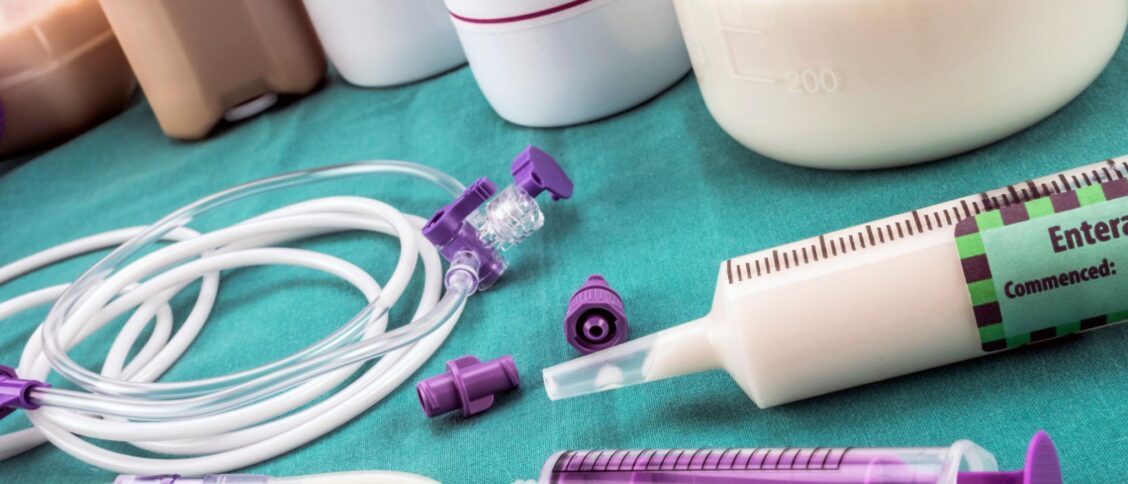

When a patient cannot meet their nutritional needs through normal oral eating — whether after a stroke, due to swallowing difficulties, head and neck cancer treatment, or a neurological condition — enteral nutrition (tube feeding) becomes essential to recovery and survival. Managing enteral feeding at home in the UAE requires the right formula, the right equipment, and the right technique. This guide is written for families, caregivers, and home nursing teams setting up or managing tube feeding outside of a hospital setting.
What is enteral nutrition?
Enteral nutrition delivers liquid nutritional formula directly into the gastrointestinal tract through a tube — bypassing the mouth and throat while still using the gut for absorption (unlike parenteral nutrition, which bypasses the gut entirely via IV).
The formula provides all the macronutrients (protein, carbohydrate, fat), micronutrients (vitamins and minerals), and calories the patient needs. Modern enteral formulas like Fresubin and Ensure are carefully engineered to meet the specific needs of different patient populations.
Enteral feeding is always prescribed and supervised by a physician or clinical dietitian. The home caregiver or nursing team manages the practical delivery.
Types of enteral feeding access
The type of tube determines how feeding is managed at home:
Nasogastric tube (NGT)
A fine-bore tube passed through the nose, down the oesophagus, and into the stomach. NGTs are typically inserted in hospital and managed at home for shorter-term feeding needs (weeks to a few months). They are visible externally and require secure fixation to prevent accidental removal.
PEG tube (Percutaneous Endoscopic Gastrostomy)
A tube inserted directly through the abdominal wall into the stomach under endoscopic guidance. PEG tubes are the preferred option for long-term home enteral feeding (months to years) — they are more comfortable, less visible, and lower risk of accidental displacement than NGTs. PEG insertion is performed in hospital; ongoing management can be handled at home.
PEJ tube (Jejunostomy)
Similar to PEG but positioned in the jejunum (small intestine) rather than the stomach. Used when there are gastric motility issues or reflux risk. Requires continuous pump feeding rather than bolus feeding.
Enteral feeding formulas available in the UAE
Fresubin (Fresenius Kabi)
Fresubin is one of the most widely prescribed enteral nutrition brands across UAE hospitals and home care settings. MedicalMart stocks multiple Fresubin variants:
Fresubin 2 kcal HP / 2 kcal HP Fibre A high-protein, energy-dense formula providing 2 kcal per ml. Suitable for patients with increased energy and protein requirements — post-surgical recovery, pressure ulcer healing, and patients with limited feeding volume capacity. The Fibre variant includes a mix of soluble and insoluble fibres to support bowel function. Available at MedicalMart: AED 35 per unit
Fresubin 2 kcal DRINK / 2 kcal Fibre DRINK The same energy density in a ready-to-drink format — suitable for patients with some oral intake capacity who supplement with sip feeds, or as an oral nutritional supplement (ONS) alongside partial tube feeding. Available at MedicalMart: AED 15 per unit
Other Fresubin variants for specific clinical needs (diabetic formulas, renal-adapted, immune-modulating) can be ordered through MedicalMart’s pharmacy team.
Abbott Ensure
Ensure Liquid 250 ml Ensure is a well-established oral nutritional supplement used widely across the UAE for patients with reduced appetite, malnutrition risk, or increased nutritional needs. Available as a ready-to-drink supplement. Available at MedicalMart — see product page for current pricing
Ensure is not typically used for tube feeding — it is primarily an ONS (oral nutritional supplement). For tube feeding, Fresubin and similar purpose-built tube formulas are the standard.
Enteral feeding pumps: the Kangaroo ePump
For continuous or overnight feeding — or when bolus feeding is not appropriate — an enteral feeding pump delivers formula at a precisely controlled rate.
Kangaroo ePump Enteral Feeding Pump
The Kangaroo ePump is one of the most widely used enteral feeding pumps in clinical and home settings globally. Key features:
- Precise flow rate control (1–300 ml/hr)
- Audible and visual alarms for occlusion, air-in-line, and end-of-feed
- Compatible with standard enteral giving sets
- Compact and portable — fits on a standard IV pole or can be used freestanding
- Long battery life for overnight or mobile feeding
MedicalMart stocks the Kangaroo ePump — view the product page.
Other equipment needed alongside the pump:
- Enteral giving sets (single-use, changed every 24 hours)
- Enteral syringes (60 ml ENFit or catheter-tip — confirm which connector your patient’s tube uses)
- ENFit connectors (the international standard for enteral connections — prevents dangerous misconnections with IV lines)
- Feeding pole or stand
- Formula containers or bags
Feeding schedules: bolus, intermittent, and continuous
Bolus feeding delivers a set volume (typically 200–400 ml) over 15–30 minutes by gravity or syringe, 4–6 times per day. It mimics normal meal patterns and is used mainly for PEG-fed patients with adequate gastric function.
Intermittent feeding delivers larger volumes over 1–4 hours, typically using a gravity set or pump. More controlled than bolus, less demanding than continuous.
Continuous feeding delivers formula at a slow, steady rate over 16–24 hours using a pump. Used for jejunostomy feeding, patients with poor gastric tolerance, and overnight supplemental feeding.
Your clinical dietitian or hospital discharge team will specify which schedule is appropriate for your patient.
Practical homecare tips for tube feeding
Positioning: Always elevate the head of the bed to at least 30–45° during feeding and for 30–60 minutes after bolus feeds to reduce aspiration risk.
Tube flushing: Flush the tube with sterile water before and after each feed and after medication administration — a minimum of 30 ml for adults. Use the volume recommended by your clinical team for paediatric patients.
Formula handling: Open formula containers should be stored in the refrigerator and used within 24 hours. Never use expired formula. In the UAE’s hot climate, never leave open formula at room temperature for extended periods.
Medication administration: Many medications can be given through the tube — but tablets must be properly dissolved, and some medications are unsuitable for tube administration. Always confirm with your pharmacist.
Signs to watch for: Contact your healthcare team immediately if the patient develops nausea, vomiting, bloating, or diarrhoea that is new or worsening; if the tube appears to have moved or has come out; or if there is pain or redness at a PEG site.
Frequently asked questions
Can I buy Fresubin without a prescription in the UAE? Fresubin is a medical food (not a pharmaceutical drug) and is available from licensed medical suppliers like MedicalMart. However, enteral feeding formulas should always be used under guidance from a physician or dietitian who has assessed the patient’s nutritional requirements.
How do I know how much Fresubin to give per day? Your clinical dietitian will calculate the required volume based on the patient’s weight, energy needs, protein requirements, and any clinical condition affecting metabolism. Do not determine volumes independently — incorrect feeding (under or over) has significant clinical consequences.
Does MedicalMart sell enteral giving sets and enteral syringes? Yes. Contact our team at pharmacy@medicalmart.ae or +971 55 360 3679 to enquire about current stock of enteral giving sets, ENFit syringes, and feeding bags compatible with the Kangaroo ePump and other pump systems.
Can the Kangaroo ePump be rented rather than purchased? Pump rental arrangements are available through some homecare providers in the UAE. MedicalMart sells the pump outright. For long-term home use (months to years), purchase is generally more cost-effective than rental. Contact us to discuss the options.
What happens if the formula is not available and we need to switch brands? Switching enteral formula brands or variants should be done under dietitian supervision — different formulas have different calorie densities, osmolarity, and fibre content, which can affect tolerance and bowel function. Contact your dietitian or our pharmacy team before making any substitution.
Order enteral nutrition products with UAE-wide delivery
Browse MedicalMart’s nutrition range — including Fresubin, Ensure, and the Kangaroo ePump — available for fast delivery across Dubai, Abu Dhabi, Sharjah, and all UAE Emirates.
For clinical enquiries, bulk orders, or formula substitution advice, contact our pharmacy team: pharmacy@medicalmart.ae | +971 55 360 3679
This guide is for informational purposes. Enteral nutrition must always be prescribed and supervised by a qualified physician and clinical dietitian. Do not commence or alter tube feeding without professional guidance.