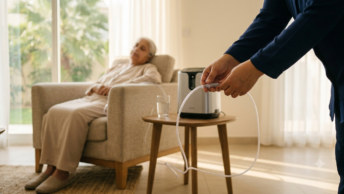
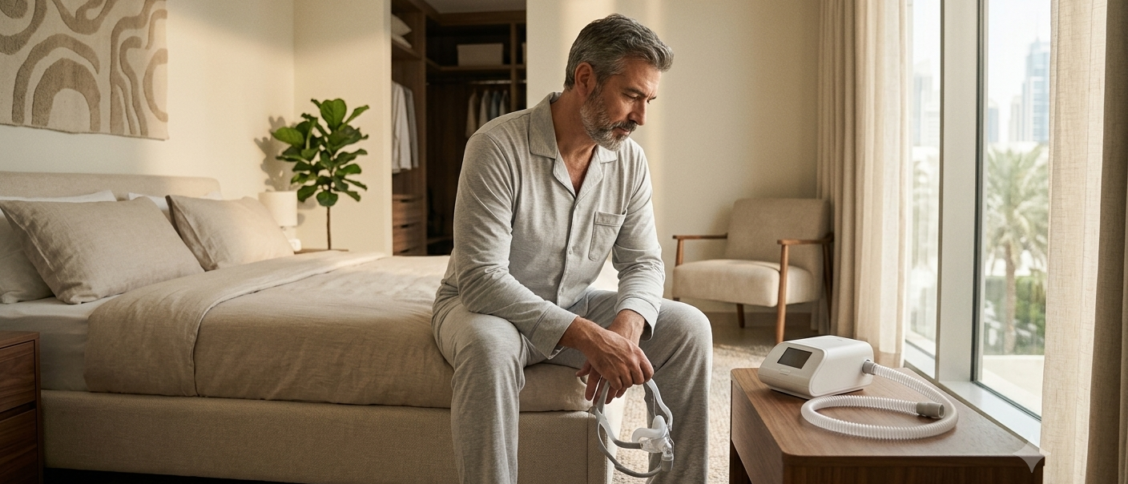

This guide compares CPAP and BiPAP machines at a practical level, explaining how the two devices differ, the factors that typically influence which one a doctor recommends, and what to consider when buying and maintaining one in the UAE. It does not diagnose sleep apnea or recommend a specific device for your situation; that decision belongs with your sleep specialist.
This article is for general informational purposes only and does not replace professional medical advice. Consult a licensed healthcare provider for guidance specific to your condition.
What CPAP and BiPAP Have in Common
Both CPAP (Continuous Positive Airway Pressure) and BiPAP (Bilevel Positive Airway Pressure) machines are designed to keep the airway open during sleep by delivering pressurized air through a mask. Both are used to manage sleep-disordered breathing conditions, and both require a mask, tubing, and a device unit that a patient uses nightly, generally as prescribed following a sleep study.
The Core Difference: One Pressure vs Two
CPAP delivers a single, constant air pressure throughout the entire breathing cycle, whether the user is inhaling or exhaling. It is the more commonly prescribed starting point for many patients with obstructive sleep apnea.
BiPAP delivers two different pressure levels: a higher pressure during inhalation and a lower pressure during exhalation. This can make breathing out feel more natural for some users, and BiPAP is often considered for patients who find a single constant pressure difficult to tolerate, or who have specific respiratory conditions where varying pressure levels are clinically appropriate.
The choice between the two is a clinical decision made after a sleep study and consultation with a sleep specialist or pulmonologist, factoring in the severity and nature of the patient’s condition. This article’s comparison is meant to help you understand the terminology, not to guide that decision yourself.
Comparing the Two at a Glance
| Feature | CPAP | BiPAP |
|---|---|---|
| Pressure delivery | Single constant pressure | Two alternating pressure levels |
| Common use case | Frequently the first-line device for many patients | Often considered when a single pressure is hard to tolerate or for specific respiratory needs |
| Typical unit size | Compact | Slightly larger due to added mechanism |
| Adjustment complexity | Simpler pressure settings | More adjustable pressure parameters |
Mask Types: A Separate but Related Decision
Both CPAP and BiPAP machines connect to a mask, and mask choice affects comfort and adherence as much as the machine type:
- Nasal masks cover only the nose and are generally more compact.
- Full-face masks cover the nose and mouth, often chosen for patients who breathe through their mouth during sleep.
- Nasal pillow masks are minimal, sitting just at the nostrils, and can suit users who prefer less facial contact.
Trying different mask styles, where possible, can make a meaningful difference in comfort and long-term consistent use, and your provider or a respiratory equipment specialist can advise on fit.
Practical Buying Considerations in the UAE
Noise and household setup: Since these machines run throughout the night, consider bedroom layout and whether a quieter unit matters for a shared room.
Power and travel: If the user travels within the UAE or abroad, check whether the device has a travel-friendly size and confirm voltage compatibility for the destination.
Climate and humidification: Many CPAP and BiPAP machines include a humidifier attachment, which can help offset the dryness common in air-conditioned indoor environments across the UAE, particularly during the hotter months when AC use is constant.
Cleaning and filters: Masks, tubing, and water chambers need regular cleaning, and filters need periodic replacement to maintain air quality and device performance; follow the manufacturer’s guidance.
Sourcing from an approved retailer: Buying from a DHA-approved supplier provides some assurance around product sourcing for this kind of equipment.
Delivery and support: Standard delivery for in-stock respiratory equipment is 7–10 days, with a flat AED 20 shipping fee across all seven Emirates. Institutions such as sleep clinics or hospitals needing multiple units can use B2B or bulk ordering.
You can browse CPAP, BiPAP, and other respiratory equipment at https://www.medicalmart.ae/category/airway-and-respiratory to compare available options.
Frequently Asked Questions
Is BiPAP always a better option than CPAP?
Not necessarily. CPAP is often the first-line option for many patients with obstructive sleep apnea, while BiPAP may be considered for those who struggle to tolerate constant pressure or have specific respiratory needs; the appropriate choice depends on a sleep study and a specialist’s assessment.
Do I need a prescription to buy a CPAP or BiPAP machine in the UAE?
These devices are typically prescribed following a sleep study and consultation with a sleep specialist or pulmonologist, who will also specify the pressure settings needed.
How often should CPAP or BiPAP masks and tubing be replaced?
Replacement schedules vary by manufacturer and usage, so it’s best to follow the device manufacturer’s guidelines or your healthcare provider’s recommendation rather than a fixed timeline.
Can a humidifier attachment help with dryness from air conditioning?
Many CPAP and BiPAP units offer an optional humidifier attachment that can help with the dryness some users experience in air-conditioned rooms; ask your provider whether it’s suitable for your setup.
Does Medicalmart Pharmacy deliver a CPAP or BiPAP machine to Sharjah, Ajman, Fujairah, Ras Al Khaimah, and Umm Al Quwain, not just Dubai and Abu Dhabi?
Yes. Medicalmart Pharmacy delivers across all seven Emirates using the same standard 7–10 day delivery window and flat AED 20 shipping fee, regardless of which Emirate you’re ordering to.
Is there a difference between ordering from the Dubai branch and the Abu Dhabi branch?
No — both the Al Hudaiba, Dubai branch and the Khalidiya, Abu Dhabi branch draw from the same catalog and pricing, so an order placed online is fulfilled the same way regardless of which branch is closer to you. In-person viewing is available at either location.
Which Emirate has the nearest physical branch to visit before buying?
Medicalmart Pharmacy has two physical branches — Al Hudaiba in Dubai and Khalidiya in Abu Dhabi. Customers in Sharjah, Ajman, Fujairah, Ras Al Khaimah, or Umm Al Quwain order online with delivery, since there is currently no physical branch in those Emirates.